
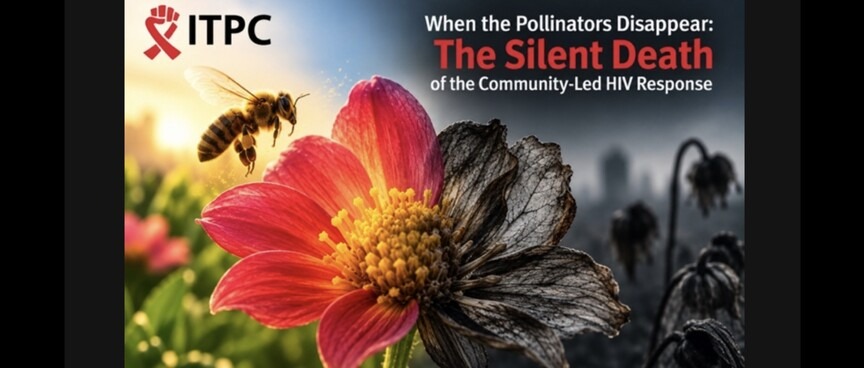
Why protecting community-led organisations is a test of political leadership, accountability and global solidarity. A blog contribution by Solange Baptiste, ITPC Global and Robin Montgomery, Robin K Montgomery Consulting
Imagine a world without bees.
At first, the landscape might appear unchanged. Flowers would still bloom, trees would still stand, and fields would remain green. But beneath this apparent normality, an ecological crisis would be unfolding. Without pollinators, biodiversity would decline, food production would suffer, and the relationships sustaining entire ecosystems would begin to unravel.
Now imagine a global HIV response without community-led organisations.
Hospitals would remain open. Antiretroviral medicines might still be available. Governments would continue implementing national HIV strategies, and international institutions would continue reporting progress against global targets.
Yet something fundamental would be disappearing: the community infrastructure that connects people to services, translates scientific advances into equitable access, builds trust, protects human rights and holds institutions accountable.
Just as bees sustain natural ecosystems, community-led organisations are the pollinators of the HIV response. Their disappearance would not simply mean the closure of individual organisations. It would threaten the relationships, knowledge, leadership and collective power upon which decades of progress depend. And therein lies the danger: we may continue celebrating progress while overlooking the erosion of the very infrastructure that makes it possible.
The ecosystem we cannot afford to lose
Community-led organisations connect people living with HIV and those most affected by HIV to prevention, testing, treatment and care. They translate complex biomedical innovations into information people can understand, trust and use. They identify barriers that formal health systems often overlook and connect communities to decision-making spaces from which they have historically been excluded.
For people who use drugs, sex workers, LGBTQI+ communities, migrants and others experiencing criminalisation or discrimination, these organisations are often the trusted entry point into healthcare.
The value of this infrastructure is measurable. In Malawi, community-led monitoring identified serious gaps in access to rapid TB diagnostics. Community advocacy helped secure a Global Fund commitment to procure 50 additional GeneXpert machines. At monitored facilities, TB diagnoses and treatment initiations nearly tripled, from 320 in 2022 to 907 in 2023. This is what happens when community intelligence informs investment decisions: problems are identified, resources are redirected, and more people access lifesaving care.
But what happens when this infrastructure disappears?
When a community-led organisation closes, the immediate consequences may be visible: lost jobs, discontinued programmes, reduced outreach and fewer people accessing services.
But the deeper damage is less easily measured.
Years of trust-building disappear. Peer networks fragment. Community knowledge and technical expertise are lost. Advocacy coalitions weaken. The independent mechanisms through which communities identify service failures, challenge discrimination and demand accountability begin to erode.
A government clinic may absorb some services previously delivered by a community organisation. But service substitution is not the same as replacing community infrastructure.
An institution can inherit a programme without inheriting the trust that made it effective. It can deliver medicines without restoring the relationships that enabled people to access them.
And once these relationships disappear, rebuilding them can take years.
The dangerous illusion of sustainability
One of the greatest risks is that the HIV response may continue to appear successful even as its foundations weaken.
This is not a hypothetical risk. In April 2025, UNAIDS reported that 40% of its reporting country offices had experienced the cessation of community-led services following US funding cuts, compared with just 3% reporting the cessation of government services. The formal health system may remain standing even as the community infrastructure connecting people to that system disappears. This is the silent collapse we should be measuring and preventing.
Treatment coverage, viral suppression, testing rates and prevention uptake are essential measures of progress. But they do not necessarily tell us whether the community systems enabling that progress are surviving.
A country may report strong treatment outcomes while community organisations lose funding and marginalised populations become increasingly disconnected from care.
New prevention technologies may become available while the organisations best positioned to generate demand, address mistrust and challenge access barriers are disappearing.
The presence of medicines does not guarantee access. The existence of services does not guarantee inclusion. And achieving biomedical targets does not necessarily mean the HIV response is sustainable.
We need to rethink what sustainability actually means. It cannot be measured solely by whether services, medicines and programmes continue when external financing declines. It must also consider whether communities retain the infrastructure, resources, independence and power to make those services effective, equitable and accountable.
A functioning programme is not necessarily a sustainable response. If clinics remain open while trusted community networks disappear, or treatment continues while community oversight vanishes, we may be preserving institutions while undermining the very conditions that sustain progress.
The greatest danger is not simply that community-led organisations are disappearing. It is that we may fail to recognise the consequences until the HIV response itself begins to unravel.
Political leadership means protecting what makes progress possible
The growing fragility of community-led organisations raises a fundamental question about political priorities.
If governments and donors recognise these organisations as essential to reaching marginalised populations, sustaining treatment and protecting human rights, why are their core functions so often dependent on insecure, short-term financing?
Why do we continue to treat community leadership as a project activity rather than essential health infrastructure?
These are not simply technical financing questions. They are questions of political leadership and accountability.
Political leadership is not demonstrated only by announcing ambitious targets or making financial pledges. It is demonstrated by making difficult choices, protecting essential investments and honouring commitments when circumstances become challenging.
And accountability means more than reporting how much money has been pledged. It means ensuring that commitments translate into resources, that resources reach the institutions and communities that need them, and that those most affected have meaningful power to influence how decisions are made.
Political leadership must therefore be judged not only by the commitments made, but by the essential functions protected when resources become scarce.
We cannot protect biomedical investments by dismantling the community systems that make those investments work.
From promises to protection
The Global Fund has demonstrated the importance of sustained investment, committing approximately US$5.9 billion to health and community systems between 2024 and 2026—a 43% increase over the previous grant cycle. But its Eighth Replenishment, which secured US$12.64 billion in pledges, comes at a moment when financing pressures threaten precisely the community infrastructure that these investments have helped sustain. The challenge is no longer how much funding is mobilised, but what we choose to protect with it.
Political accountability now means ensuring that commitments are honoured and that the resources protect the community infrastructure essential to delivering results. A pledge is not an outcome. Its value lies in what it enables and what it prevents from disappearing.
Donor governments must convert their pledges into timely, predictable financing. Countries must protect community-led responses within national priorities and financing arrangements. And the Global Fund and its partners must continue championing flexible, sustained investment in community infrastructure.
That means protecting independent advocacy, community-led monitoring, peer networks, leadership development and the organisational capacity needed to sustain community action.
It also means recognising that communities are not simply beneficiaries or implementing partners. They are essential actors in governance, decision-making and accountability.
When funding decisions are made, communities must have the power to help determine what is protected, what is prioritised and what must change.
The disappearance of community-led organisations is not an inevitable consequence of economic uncertainty. It reflects choices about whose contributions are valued, whose voices matter and which parts of the health system are considered indispensable.
Those choices can—and must—be different.
When the pollinators disappear
The world has invested enormously in the science, medicines and technologies needed to end AIDS as a public health threat. But scientific progress alone cannot deliver equitable access or sustainable outcomes.
Those achievements depend on communities having the organisations, resources, leadership and power to translate scientific possibility into lived reality.
The lesson from nature is simple: ecosystems survive because their interconnected parts sustain one another.
We cannot expect the HIV response to flourish while allowing its pollinators to disappear.
Political promises must become financial commitments. Financial commitments must become sustained investments. And political accountability must mean protecting not only the services we can count, but the community infrastructure we cannot afford to lose.
Because when the pollinators disappear, what is at risk is not simply their survival.
It is the survival of the entire ecosystem that depends on them.