
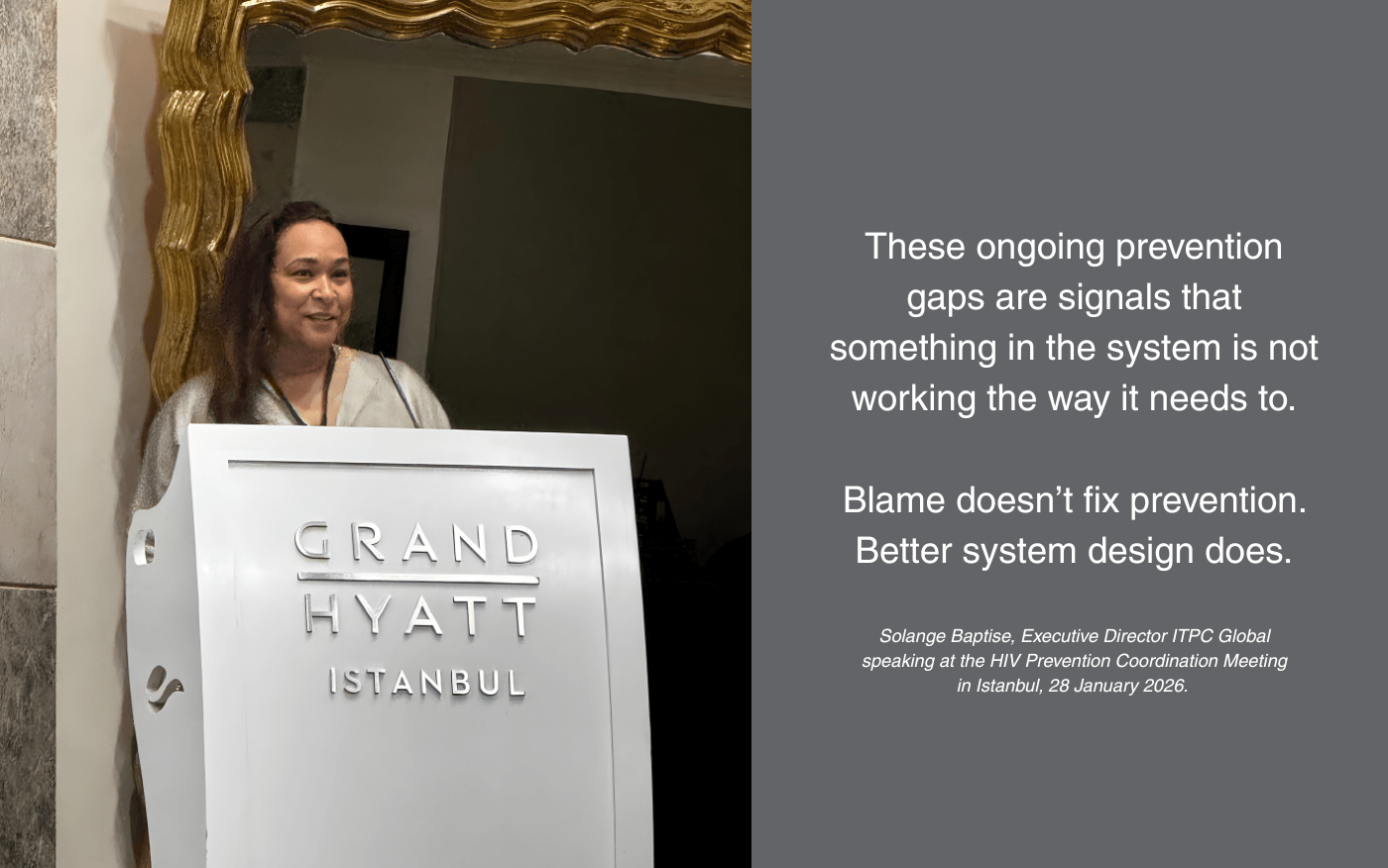
Solange Baptiste, Executive Director of ITPC Global, delivered opening remarks at the Gates HIV Prevention meeting held in Istanbul on 28 January 2026. Her speech reflects on HIV prevention coordination from a community perspective, highlighting the importance of system design, accountability, and lived realities in shaping effective prevention responses.
Thank you for the opportunity to share some reflections on HIV prevention coordination from a community perspective. The perspective I’m bringing reflects what I’ve heard from communities in this room and from partners we work with every day.
It is difficult to talk about HIV prevention coordination without also talking about the wider prevention strategy that we are agreeing to, especially in this new and increasingly hostile environment the HIV sector now finds itself in – the world we really live in, not the one we wish we lived in…
This then led me to the question: If we had to grade ourselves on the global prevention strategy today, what would that grade be?
Prevention is difficult by nature. It asks people to act against risks they can’t yet feel, and it delivers benefits that are invisible when it succeeds. When it falls short, we too often turn system failures into personal blame.
The problem isn’t commitment or effort—It’s that we’ve asked prevention to succeed in systems that don’t support how humans actually live.
We are having a coordination conversation in the context of health system failure. Context shapes meaning. Form follows function. We are operating in a moment of shrinking resources, rising political resistance, donor transitions, and growing pressure on governments to do more with less. This is the context that brings us together to talk prevention…which for us means that coordination cannot be a technical exercise of fitting parts together or renewing x grant not y. It has to be a strategic one.
We can all agree that HIV Prevention is shaped by poverty, gender inequality, stigma, migration, conflict, climate shocks, and fragile health services. When prevention fails, it is rarely because people don’t care or don’t know. It is because the systems around them are not designed for the realities they are living in. The ongoing prevention gaps cannot be taken as individual failure or poor choices. These gaps are signals that something in the system is not working the way it needs to. Blame doesn’t fix prevention. Better system design does.
If we frame prevention coordination as something ministries can solve on their own, or as a set of global platforms talking to each other, we will miss where prevention actually breaks down.
Prevention is connected to treatment, to sexual and reproductive health, to primary care, to rights, to education, and to economic security. It also has to fit into an individual’s life. For most people, prevention is not the main priority they wake up with each day. Safety, food, income, and dignity often come first.
If prevention strategies do not connect to that broader context, they will not hold. This is also why it is misleading to reduce prevention to products alone. Communities want choice, real choice, including long-acting options.
Every biomedical tool still has to move through stigma, fear, clinic readiness, provider attitudes, supply chains and social judgment. Without education, real choice and sustained support, even the best science will fail to translate into impact (not number of persons reached but persons using a prevention model).
So, when we talk about coordination, we need to ask a more honest question: what exactly are we coordinating?
Are we coordinating institutions and strategies? Or are we coordinating the work that makes prevention usable, trusted, and sustained at country and community level?
From a community perspective, 3 things are critical.
First, information flow. High-level decisions, diagnostics, and coordination discussions often do not reach the grassroots. Communities are expected to implement strategies they did not shape and are not fully informed about. If coordination does not improve how information moves down and back up the system, then it is adding burden, not value.
Second, accountability. Structural and discriminatory barriers, stigma, criminalization, gender inequality, are well known, yet they remain poorly addressed and weakly linked across systems. These are not side issues. They are central to prevention success or failure. No one wants to deal with this. This is where community-led monitoring becomes essential. Community monitoring is not storytelling. It is how systems learn in real time where prevention is working, where it is failing, and why. Without that feedback loop, coordination becomes disconnected from reality.
Third, financing. We need to be very clear about who is paying for prevention going forward. Which governments can realistically carry this work? Which donors are stepping up? And what happens to coordination functions when grants end? Communities are often the only actors that remain when funding cycles shift, yet community systems are rarely treated as essential prevention infrastructure.
And finally, connection across geographies. All prevention is local but learning and support cannot stop at borders. Countries and communities need ways to learn from each other in real time, grounded in lived experience, not just global reports.
My hope is that we resist the temptation to make this neat or narrow. Prevention is not a theory. While nothing I’m saying is necessarily new, the issue isn’t awareness, it’s what about what we choose to act on. So yes, we can talk about coordination. But let’s be clear about what we are coordinating, who is paying for it, and who is expected to do the work, especially in a moment when long-standing institutions are under strain and certainty is in short supply.
If this discussion is going to matter, it has to stay grounded in real lives, real systems, and real accountability.